


Caregivers Out Loud
When a care recipient with Alzheimer’s or dementia cannot interact like they used to, how do you forge connections in a new way? That’s the question Helga Strauss was faced with when she became a caregiver for her father. Seeking the joy and laughter they had always shared, she turned to visual art—and suddenly, a practice she had always loved rekindled the pathways between them.
Today, Helga is a certified therapeutic art practitioner, educator, and artist. In her personal art practice, she creates art every day, following her joy and curiosity. As a teacher for over 30 years, she encourages her students to do the same. Her mission is to help people spark joy, connection, and healing through creative, art-filled play.
She applies the skills she developed, while scribbling and dancing to meaningful songs with her father, to assist others in similar situations. Both caregivers and care recipients can discover the power of enjoying the moment and focusing on the process, rather than trying to “fix” or revert to a former self. The pride and joy that come from creating art foster a new way of listening, enabling self-expression and helping to process pain, ultimately rebuilding those precious shared connections.
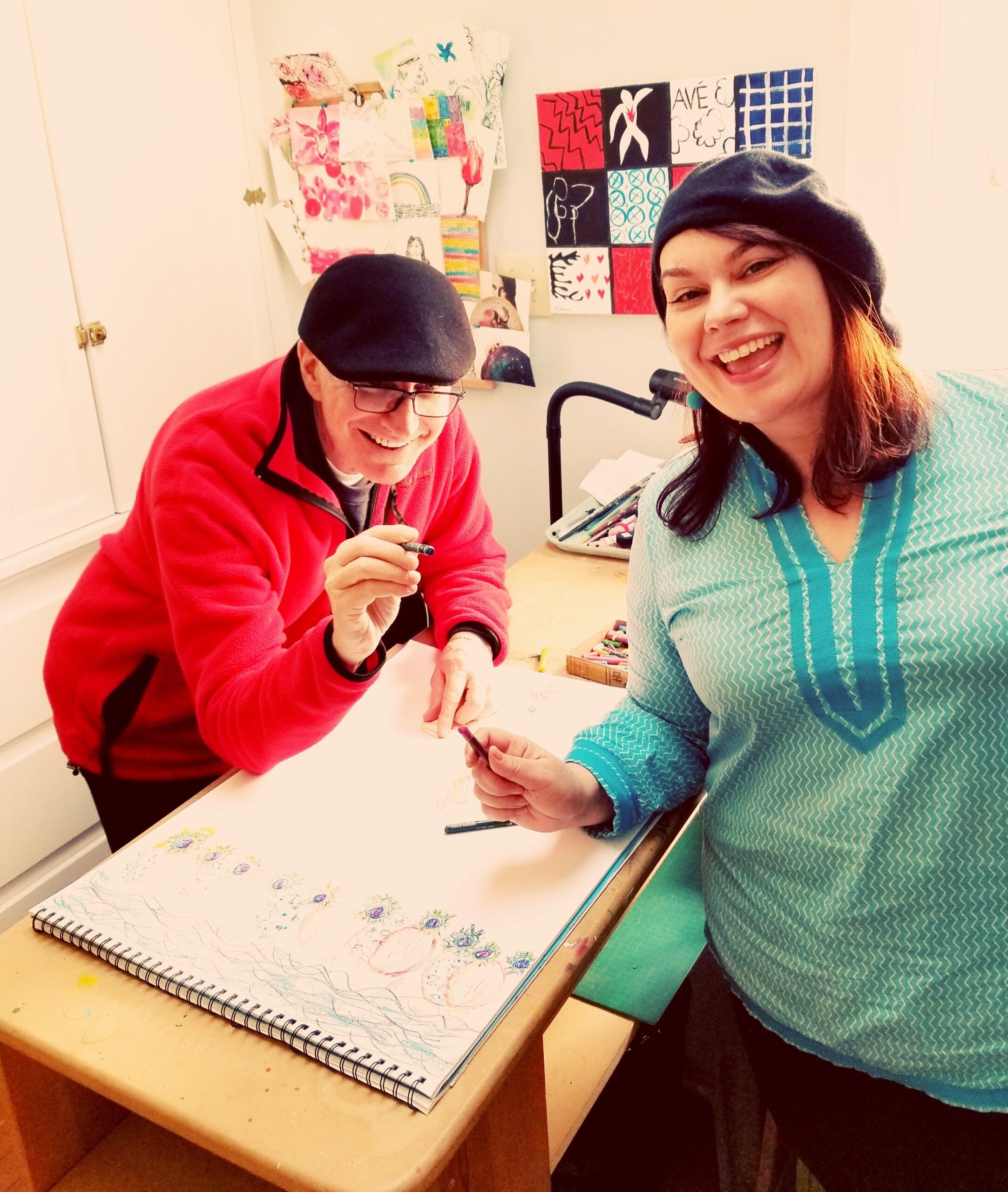
Learn from Helga’s welcoming and creative approach to caregiving:
- How a care recipient’s physical and mental health can be revealed through art;
- The impact of playing songs from a care recipient’s teenage years;
- The simple, flexible options available to anyone who wants to introduce art into their caregiving;
- Why everyone should try scribbling with both their hands.
- When to set aside your ego so your parent can retain their dignity;
- How to advocate for a parent’s care while also respecting healthcare professionals;
- Why even the most loving children must develop boundaries when caring for their parents;
- How setting caregiving goals early on can transform your mindset in the end.
Follow and Subscribe to Listen
Quotes from Helga Strauss:
- “So I put that music on, and then we just started scribbling. We just started scribbling on that giant piece of paper together, you know, and then dancing to the music while we were scribbling. Sometimes he would, like, scribble on, whenever I was drawing, so I would just scribble on what he was drawing. And there was so much laughter and fun that came out of it.”
- “I could see when he was struggling as well. You know, there was at one point where he was painting in very dark colours, blacks and browns, which was very unlike him. And so that’s when I said to my Mom, I said, I think Dad’s in pain. You know, this, there’s something. Something not right showing up when he’s doing his art. And so she got him into the doctor, and it turns out that he had a urinary tract infection.”
- “I actually teach art sessions at a local care home. And so at times I’ll bring in clay. One of the gals there, whenever she has clay in her hands, she turns into a little girl. She, she is, she’s you know, probably in her 80s but she is like 5. When she has clay in her hands, it is the cutest thing you’ve ever seen. And you know, I asked her about it, I said, you know what’s happening? I see you’re just lighting up with this clay. And she said, oh, my dad used to do clay with me when I was a little girl. And it’s, oh it’s so incredible. We all respond to different art materials differently based on our history.”
Resources
- Listen to episode 14 about the benefits of creativity – https://www.familycaregiversbc.ca/podcast/episode-14-creativity-as-a-form-of-self-care
- Explore Art for Wellness with Helga at Emily Carr House in Victoria – https://www.eventbrite.ca/cc/art-for-wellness-3430419
- Learn more about Helga – https://www.helgastrauss.com/
- Family Caregivers of BC Caregiver Support Line – 1-877-520-3267 (Monday through Friday 8:30am to 4pm PT)
Connect With Us!
- Family Caregivers of BC Website
- Telephone: (250) 384-0408
- Toll-Free Line Within BC: 1-877-520-3267
- Email: info@familycaregiversbc.ca
Visit us at our office:
#6 – 3318 Oak Street,
Victoria, BC
V8X 1R1
Hours are Monday through Friday, 8:30 am to 4:00 pm
Follow us on Social Media
Thank You
- BC Ministry of Health- Patients as Partners Initiative
- Organized Sound Productions
Transcript
[MUSIC IN // INTRO]
VOICE-OVER: You’re listening to “Caregivers Out Loud”, powered by Family Caregivers of British Columbia and hosted by Bill Israel.
[MUSIC DEVELOPS]
BILL: Imagine this, your care recipient has early or middle-stage dementia. You never know how they’ll react each day or moment, and the connection is limited. But what if, you start your day by using art, music, or dance to help get a feel for how the day could unfold. Would they recognize the song? How much are they participating? These small indications can help you prepare for the day and understand where your care recipient’s mentality is at.
HELGA: Just doing art with him made him come alive. And I said, oh, I need to. I want to help other people come alive through art making as well.
BILL: That’s Helga Strauss. Through her role as a family caregiver with her dad, Helga wanted to become certified as a therapeutic arts practitioner, which she completed in 2022. So, to understand her deep connection between art and caregiving, let’s step back to when Helga first began to see the need for her to take on some serious caregiving responsibilities. What was Helga thinking as she entered this caregiving territory?
[MUSIC FADES]
HELGA: So just before the pandemic, I was an events planner, and my dad was in the early stage of Alzheimer’s. And so he was going to a day program at a local care home. All of his programs were cancelled. And so that left him just with my mom, my mom doing all of the caregiving. And as you can remember, that was a really scary time. We didn’t know what was happening. I would get their groceries for them and bring it to them, and I realized pretty quickly that if I didn’t step in to help take care of my dad, I was going to lose them both.
BILL: Wow.
HELGA: My dad and I had always been very close. You know, my dad was my mentor, my good friend. I just loved him so much. And we would have so much fun together always. And so then he was, he was in a place where he. Like I said, he was at an early stage of Alzheimer’s, where he was at that stage where he was pretty much speaking word salad, where, you know, some of it made sense, a lot of it didn’t.
And so, I was in a place where I was trying to connect with him, you know, because we always had such a close connection. So I was trying everything, you know, different ways to connect, whether that was through, you know, singing, karaoke. I bought a record player because I thought, ooh, I’ll play music for him. And if he can actually see the physical record going on to the record player and he could hold the record album, you know, that that would cue in what was happening.
I started reading a lot too, about Alzheimer’s and how to, repetition, repetition of events is, really gives a sense of comfort and can really help as well with everything. So I started really setting up a schedule. Now, this was because, too, I mean, when I started taking care of him, I thought, well, maybe this is going to be for a week, maybe this is going to be for two weeks. We had no idea how long that the pandemic was going to go on for.
BILL: No kidding. Yeah.
HELGA: And so at that point, I had no idea I was signing up for a couple of years.
[LAUGHTER]
BILL: Wow. Wow.
HELGA: But basically, so I started using music as a way to set the stage for each activity that we would do. And I started putting together a schedule so that we would have a lot of repetition. Whenever we would sit down for our breakfast, I had a song that we would sing. And I could tell the way he sang the song if he could remember some of the words, if he couldn’t remember any of them, that would kind of give me a clue as to how the day was going to go and where he was at.
BILL: Yeah.
HELGA: So I tried that. And then eventually. So I, I’m an artist. I’ve always been an artist, my entire life. My dad was not. My dad was a very creative thinker, but he was not an artist. But. So my natural way was like, hey, can we try to connect with art? So the first thing I did was I set up, I grabbed a giant piece of paper and some crayons that I had laying around and put on some music from his teenage years that I knew, like, made him want to dance.
BILL: [LAUGHTER] Yeah.
HELGA: And so I put that music on, and then we just started scribbling. We just started scribbling on that giant piece of paper together, you know, and then dancing to the music while we were scribbling. Sometimes he would, like, scribble on, whenever I was drawing, so I would just scribble on what he was drawing. And there was so much laughter and fun came out of it.
BILL: No kidding. So the way in which you have sort of redefined how to think about art, that it’s not something you learn how to do and to make quote, unquote, good art. It is about expressing an experience.
HELGA: Absolutely.
BILL: It’s totally non-judgmental. And it’s not about trying to do something for sale or for show. It’s just a way of expressing who I am and what I’m feeling. So say more about that because music often is a good opener. And then you got out the crayons. So what was going on here?
HELGA: Yeah, it is funny how you, like, adjust the process. I teach art classes and I do art, therapeutic art sessions. And my whole thing is, let’s focus on the process. We’re not going to make any masterpieces. Don’t even try. We might end up making some by accident. Because I have to say, when you like, really allow yourself to just dive into and enjoy the creative process, it’s amazing some of the things that can come out of it just by accident.
But it’s really about being in the moment, following your curiosity as you’re in that moment. You know, maybe you see a colour that jumps out at you and you just want to scribble with that one colour because it’s lighting up inside of you. Just really leaning into the process and enjoying the process.
BILL: Sure, instead of trying to set up some established criteria. Like, I can make him make sense when he’s talking to me. You know, that might happen, it can be accidentally, but there is no objective other than getting him to say what he’s feeling, what he’s thinking, how he’s going about it in a very freeform way, crayons, or music, or I often think of childhood experience of fingerpainting
HELGA: I think of fingerpainting is fantastic, I say, yes, even think about, you know, if you want to get into exploring your creativity, you could think about what did I enjoy as a kid? What made me excited? And letting yourself play, we forget as adults, we forget how to play.
BILL: And so that’s part of this process. And you’ve made a note of that. I need to enable my father to play.
HELGA: Yes. And by him playing, you know, like I said, we started off, we were, you know, just scribbling to music on a big sheet of paper together. And I have to say that after that first day of trying that for a time, then I put that into our schedule. So every day we had art together. And eventually I was able to, I introduced watercolours. And he really got into the watercolours, which was a joy to see.
So at some point, eventually I was able to like, set up the watercolours, get it all prepared for him, and then I played the music and then he would just paint, just very much in his own headspace, in his own body, and move to the music while he was painting. I could see it was very therapeutic for him.
BILL: Absolutely. And you made the point, I think it’s a beautiful one, that this is a somatic experience. You’re not trying to correct his thinking, you’re not getting, trying to think better. And you had used the phrase about all these emotions that are floating around in his body, his heart, that he would like to have some expression for. But often, especially with dementia or Alzheimer’s, people start repeating questions. You know, they got worries. You know, there’s certain things that are going on, but you’ve skirted around that here. You sort of went to a new channel, tuned into your dad’s channel of creativity, as it were, with music, with crayons, with whatever. So the result of play, then is what, what’s happening here?
HELGA: There’s so much that comes out of play. There’s the pride that happens. You know, it’s like now, you know, I would hold up the, whatever painting that he did. I would hold it up, and we would look at it together. And, of course, I would give him praise because I still think his paintings were absolutely beautiful. Let’s face it, whenever we really express ourselves, it can be just so incredibly beautiful to the eye.
BILL: So you had to make the connection that there’s something going on with my dad that I can’t access by answering his intellectual curiosity. There’s something else that he needs to express. And that’s how you got to this art business?
HELGA: Yes. Seeing him being able to express himself, he expressed himself, I could see the joy. At times when he was painting, he would giggle. And at other times, I could see when he was struggling as well. You know, there was at one point where he was painting in very dark colours, blacks and browns, which was very unlike him. And so that’s when I said to my Mom, I said, I think Dad’s in pain. You know, this, there’s something. Something not right showing up when he’s doing his art. And so she got him into the doctor, and it turns out that he had a urinary tract infection.
BILL: Oh, my goodness. Oh, my goodness. So in this process, you’re having to listen to him differently and see him in his, I don’t know, childlike configuration, which we all have all of our life, but we don’t really, don’t know how to have access to it. And one of the things you were suggesting is some structure here. The timing, you know, that you do it the same time, maybe the same way. Can you say some more about that?
HELGA: Yes. I think the structure is hugely powerful, not only for the person who’s being taken care of, but also the caregiver, so that they have a clear structure as well. I found for myself, having that kind of, structure just allowed me to lean into each activity more, knowing that what was going to come next, even if he was, you know, struggling here and there.
Also the power of music, using the power of music for each activity, giving that as a cue to him. I felt really helped as well. And it allowed, like, giving the space of, like, okay, now I know we’re going to be doing art. We would usually tend to do it either after breakfast or after lunch, depending on where his energy was.
BILL: Yeah, yeah.
HELGA: A lot of that, too, is figuring out where your loved one is at, energy-wise. When are they going to have the most energy.
[MUSIC IN]
BILL: Although art isn’t an exact predictor, Helga’s simple structure moves you from reacting to proactively shaping your day. You get predictability and enough flexibility, to manage what can potentially be a stressful day. Without a plan, you’ll respond with whatever comes up – leaving you guessing, adding emotional strain, and making it harder to know what to do next.
So, as you bring art into your caregiving toolkit, Helga suggests starting small. You don’t have to go out and buy a whole bunch of new supplies, adding another task to your to-do list. Let the creative process become a low-effort, yet high-impact way to give yourself, and your care recipient, a moment of calm and control.
[MUSIC FADES]
HELGA: Yeah, I would say always try to use just what you have. And then down the road, if they’re really. If they really get into it, then you can explore, you know, buying different things. But just to start, getting a piece of paper, it could be, if you don’t have a big piece of paper, you could grab a paper bag and cut that in half and lay that out. And then now you have a big piece of paper.
I would recommend, taping it down if you can. If you have some, like, removable masking tape or any kind of tape that’s going to allow you to be able to hold it down and then take it off easy. I say that because especially when you put the music on and you may want to start dancing. It’s helpful the papers, taped down, but it’s not necessary.
And then, you know, we all have pens, pencils, maybe have some crayons, you know, whatever writing materials you have. I say pull a few of those out. Like you don’t want too much. You just want a little bit to start.
And then, like I said, making a playlist. I had a number of different playlists for my dad, but making a playlist with music that your loved one, you know, is really gonna, they’re really gonna get some energy from that music, that they’re really happy when they listen to it. And that’s usually finding the music from their teenage years is what’s gonna really get them going.
And I would say too, like just starting by that with like, saying okay, let’s just try it to one song, you know, let’s just try scribbling you know, whatever we want to one song, you know? And then see once you do one song, do you wanna do another one. Start it out gentle, start it out small. So often the reason we don’t do things like this is because we make it too big, you know, we gotta get new supplies, and we need an hour, and we need all these things and that never happens. But you just got to make it real simple. Like I said, just a piece of paper, whatever pen, pencil, crayon, whatever you have and some tape and music of course. And let your inner child come out and exploring some of those materials that you’re familiar with that you played with when you were a kid is so fun.
Now clay. So clay is wonderful. If you get just like a regular clay, say, at an art store, it’s often too firm to work with, especially for arthritic hands. It can be very difficult to manipulate. But there is something called air dry clay, you can find it just about anywhere and it is really soft and malleable, so very easy for all hands to use it.
I actually teach art sessions at a local care home. And so at times I’ll bring in clay. One of the gals there, whenever she has clay in her hands, she turns into a little girl. She, she is,…
BILL: Wow.
HELGA: …she’s you know, probably in her 80s but she is like 5. [LAUGHTER] When she has clay in her hands, it is the cutest thing you’ve ever seen. And you know, I asked her about it, I said, you know what’s happening? I see you’re just lighting up with this clay. And she said, oh, my dad used to do clay with me when I was a little girl.
BILL: Wow.
HELGA: And it’s, oh it’s so incredible. We all respond to different art materials differently based on our history.
BILL: Sure. And you know, the beauty of the way in which you approach it is such an open-ended way, is that we know there is a person still in there…
HELGA: Mhmm.
BILL: …that’s got a heart and maybe a broken heart or a lonely heart as well as a fun heart.
HELGA: Mhmm.
BILL: What you’re doing is just trying to find your way to those avenues without having to fix anything. Just let them in some way express it in their artistic.
HELGA: Yes, express and explore and also letting them feel that everything is right. There’s nothing, you know, there’s nothing that you can do that’s wrong or bad with this. You know, it’s all good and it’s just such a wonderful way to connect. When I do my art sessions too, I make sure that we’re all sitting around one table…
BILL: Oh wow.
HELGA: …so we can all see each other. And art is such a bonding experience too.
BILL: I want to leave our last few minutes here to ask you, are there any other things that occur to you that we haven’t covered yet about not only the challenge of this caregiving role, but the opportunities that are waiting for any family caregiver?
HELGA: Well, I can see, yes, it’s definitely a challenge. It’s a continual challenge when you are a caregiver. And so my heart goes out to all of your listeners that are taking care of their loved ones. It’s not easy. You feel alone, it’s full of emotion, a lot of emotions. One way to express them and let some of that out is by allowing yourself to explore your creativity. And that could be, you know, I’m going back to a piece of paper or a paper bag if you don’t have A piece of paper. You know, actually, if you just do some scribbling to music with both of your hands, that is huge in helping to regulate your nervous system.
It’s just very simple of just letting yourself take those pens or crayons or whatever you have around the paper and scribbling at both, like I said, using both hands is. It’s huge, the difference that it can make. And also, you know, finding some kind. Giving yourself a way to find some joy, I find for myself. I do art every day. And that’s why me taking a walk. And on my walk, I always look for something to bring into my art. Whether that’s drawing a beautiful flower I see or pressing a leaf that I see or stitching on a leaf that I see, you know, so that helps me. Keeps my eyes open to the beauty in nature every day.
So I think finding very simple ways. I know that everyone is like, especially when you’re caregiving to give yourself, even to have the time to take a walk is huge. But if you are somehow able to do that and then bring in some kind of creative element, it might be that, like, I’m, um. I’m focused on the visual arts, but, you know, there’s no. There’s a huge variety of expressive art outlets. But the key is to give yourself some way to process some of that pain and emotion that you’re going through.
[MUSIC IN]
BILL: Helga’s story is a great example of how a little curiosity, combined with experimentation, can lead to more connection. Art can create a care space that has a positive impact on your recipient and yourself as a family caregiver.
To find out more about using creativity in your caregiving role, listen to episode 14, “Creativity As a Form of Self-Care”, wherever you are listening to this episode now – and we’ll have the link in the show notes as well.
And if you or someone you know is taking on this caregiving role and is looking for help, call the Family Caregivers of BC caregiver support line. Here, you’ll access free guidance and resources like expert-led events and community support groups. Call toll-free at 1-877-520-3267.
[MUSIC CONTINUES]
As we wrap up our time with Helga, I wanted her to explore more of this connection piece. How does art create a more joyful connection in caregiving?
HELGA: When you’re trying to connect with your loved one that has dementia or maybe some other issues, and you think, like, how do I connect? I can’t connect. Try. I just want to say, try the art. Try. Try just the scribbling together. It’s amazing the difference. I found for myself, like, finally a way to bring joy and laughter back into my relationship with my dad, you know, was just so great. It was such a wonderful way to connect. And I’m so thankful that I still get to find, you know, get to connect with so many people by doing what I love and sparking joy through exploring our creativity.
[MUSIC DEVELOPS // OUTRO]
VOICE-OVER: Thank you for listening to “Caregivers Out Loud”, powered by Family Caregivers of British Columbia and hosted by Bill Israel. Produced and sound edited by Organized Sound Productions. We acknowledge the financial support of the Province of British Columbia and the BC Ministry of Health – Patients as Partners Initiative.
If you like what you’re hearing, discover more episodes, and find more caregiving resources at familycaregiversbc.ca. And if you find these episodes helpful, please share them with your family and friends who may find it enlightening to hear these stories.
Finally, don’t forget to subscribe to our show on your favourite podcast listening app, so you can take us with you wherever you go. Thank you for listening and taking the time to learn and care for yourself with other caregivers, out loud.
[MUSIC ENDS]